Explore the end-to-end engineering rigor behind cathode block alignment, delining safety, ramming paste compaction, and thermal efficiency in primary aluminium smelter maintenance.
Introduction to Modern Potline Lifecycle Management
Aluminium reduction cells operating at sustained temperatures above 950°C and handling corrosive cryolite bath require exceptional lining integrity. In modern electrolytic smelting facilities, pot life directly dictates capital efficiency and production economics. When a pot reaches the end of its design campaign—typically between 1,800 to 2,500 days—relining precision determines whether the subsequent cycle achieves maximum amperage efficiency and minimal cathode voltage drop.
At Rajendra Mechanical Private Limited (RMPL), pot relining is treated not merely as a refractory replacement exercise, but as a critical electro-thermal re-engineering task requiring micrometer-level cathode bar alignment, precise preheating thermal gradients, and systematic pneumatic ramming.
The Critical Phases of Pot Relining
1. Controlled Delining & Shell Inspection
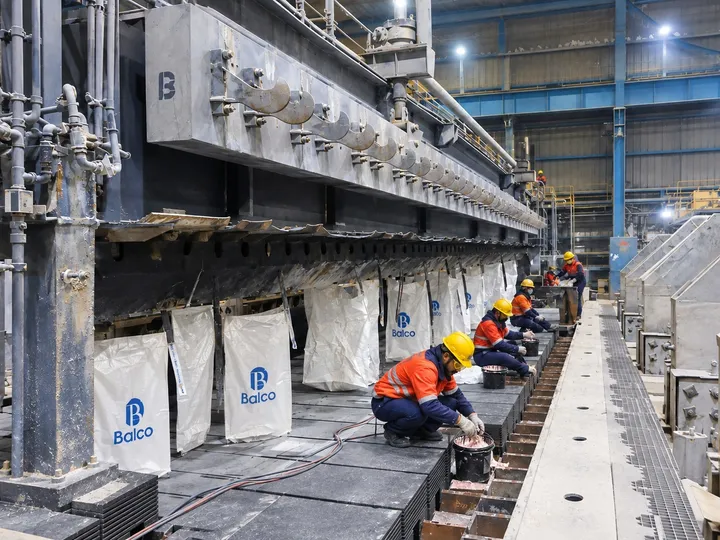
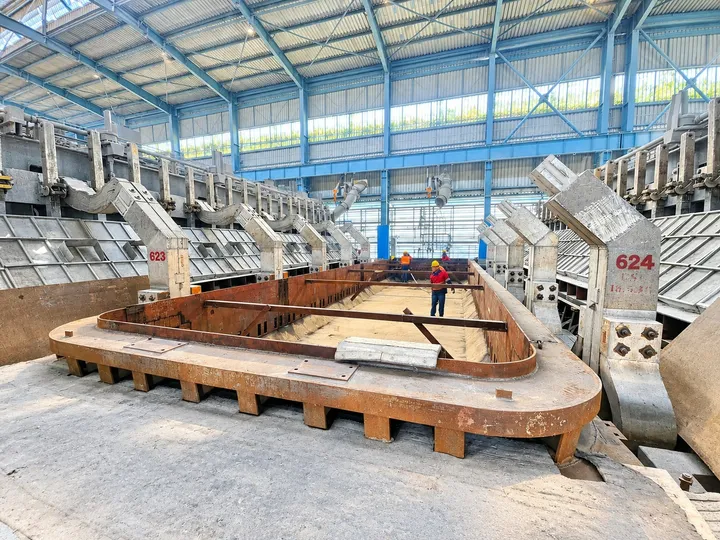
The delining phase requires controlled pneumatic de-bricking and robotic excavation to strip spent bath, cathode carbon, and degraded refractory insulation without damaging the steel pot shell.
Key milestones include:
- Ultrasonic shell thickness inspection to identify localized thermal fatigue or shell deformation.
- Riser and busbar connection audit to eliminate high-resistance electrical contact points.
- Bottom plate leveling verification, ensuring planar tolerances within $\pm 2.0\text{ mm}$ across the entire cradle.
2. Multi-Tiered Thermal Insulation & Barrier Bricking
Modern high-amperage reduction cells rely on calibrated multi-layer thermal barriers:
- Microporous high-performance calcium silicate insulation slabs.
- Dense fireclay refractory bricks to prevent molten fluoride penetration.
- High-alumina barrier tiles acting as an impervious seal against cryolitic bath attack.
Engineering Note: Precision dry-joint laying and calibrated mortar joints are verified under continuous laser level guidance to prevent thermal bridging that could induce shell hot spots.
3. Cathode Block Alignment & Carbon Sealing
Cathode carbon blocks with pre-cast collector bars are positioned using custom overhead spreader beams. Each block's elevation and transversal alignment are checked relative to the pot cradle centerline.
+-------------------------------------------------------------+
|                      MOLTEN METAL PAD                       |
+-------------------------------------------------------------+
|    CATHODE BLOCK 1    |    CATHODE BLOCK 2    |    ...      |
+-----------------------+-----------------------+-------------+
|                  COLLECTOR BAR (STEEL)                      |
+-------------------------------------------------------------+
|             HIGH ALUMINA REFRACTORY BARRIER                 |
+-------------------------------------------------------------+
|               CALCIUM SILICATE INSULATION                   |
+-------------------------------------------------------------+
4. Pneumatic Ramming & Seam Compaction
The seam joints between cathode blocks and sidewall peripheral gaps are packed with high-grade carbonaceous ramming paste. Temperature-controlled paste heating, multi-pass pneumatic tamping, and continuous density sampling ensure zero porosity.
- Target Density: Greater than $1.58\text{ g/cm}^3$ across all transversal joints.
- Temperature Window: Strict adherence to paste supplier heating parameters ($110^\circ\text{C} - 130^\circ\text{C}$) to guarantee volatile binder activation without pre-coking.
Quality Metrics & Preheating Preparedness
A completed pot undergoes rigorous quality clearance before being released for preheating:
- Cold Cathode Voltage Drop (CVD) simulation across all bar ends.
- Helium/Air leak tests on sidewall perimeters and collector bar collector pockets.
- Comprehensive QA documentation, mapping every cathode block batch number and ramming density log.
Through this disciplined methodology, RMPL has successfully executed thousands of pot relinings across major Indian smelters including Vedanta Jharsuguda, BALCO Korba, and Hindalco Hirakud, consistently delivering industry-leading turnaround times with exemplary safety standards.